
STC Micro
STC8H1K08-36I-TSSOP2051 Series 8 Bit 33MHz TSSOP-20 Microcontrollers RoHS
From
₹42.36
1,38,498 in stock
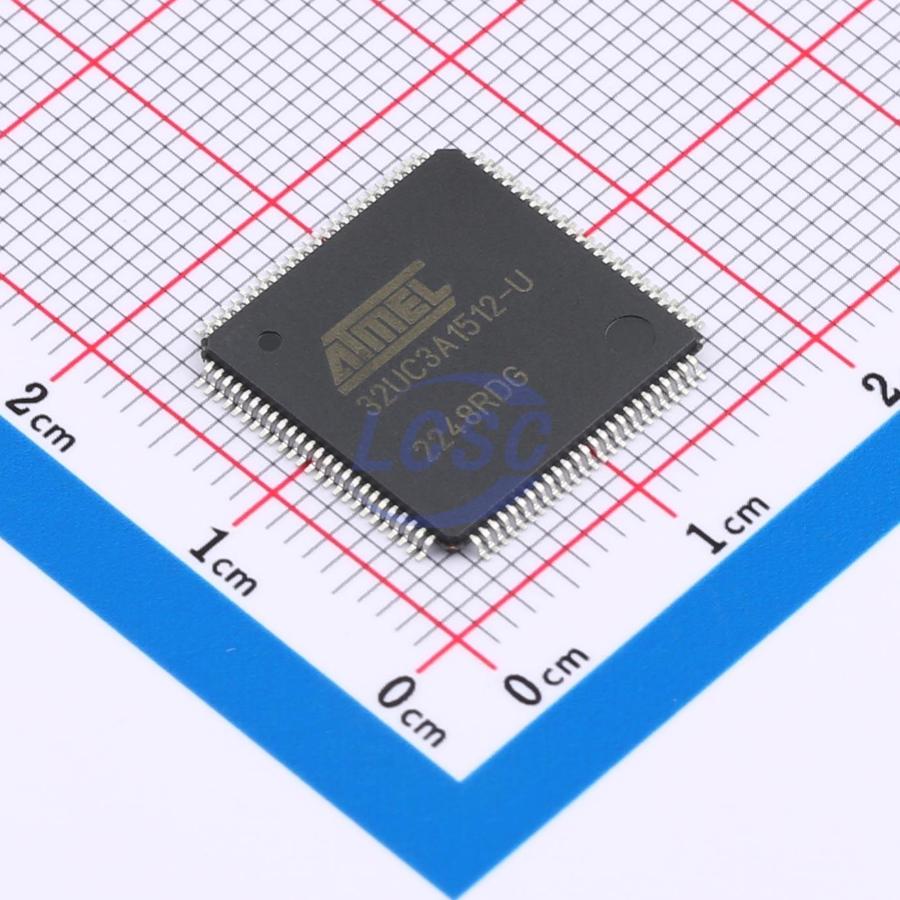
AVR 32 Bit 66MHz TQFP-100(14x14) Microcontrollers RoHS
32-bit load/store RISC architecture
Every Order Guarantee
100% Authentic · 30-Day Return or Replacement · policy
5 in stock
#C618571
Stock & price checked 3 days ago
| Quantity | Unit price | Pack price |
|---|---|---|
| 1+ | ₹3,190.49 | ₹3,190.49 |
| 10+ | ₹3,091.06 | ₹30,910.60 |
1 × ₹3,190.49
₹3,190.49
excl. GST
₹3,764.78 incl. 18% GST
AT32UC3A1512-AUT
₹3,190.49 for 1 + GST
AVR32 is a new high-performance 32-bit RISC microprocessor core, designed for cost-sensitive embedded applications, with particular emphasis on low power consumption and high code density. In addition, the instruction set architecture has been tuned to allow for a variety of microarchitectures, enabling the AVR32 to be implemented as low-, mid- or high-performance processors. AVR32 extends the AVR family into the world of 32- and 64-bit applications. The AVR32 is a new innovative microprocessor architecture. It is a fully synchronous synthesisable RTL design with industry standard interfaces, ensuring easy integration into SoC designs with legacy intellectual property (IP). Through a quantitative approach, a large set of industry recognized benchmarks has been compiled and analyzed to achieve the best code density in its class of microprocessor architectures. In addition to lowering the memory requirements, a compact code size also contributes to the core’s low power characteristics. The processor supports byte and half-word data types without penalty in code size and performance. Memory load and store operations are provided for byte, half-word, word and double word data with automatic sign- or zero extension of half-word and byte data. The C-compiler is closely linked to the architecture and is able to exploit code optimization features, both for size and speed. In order to reduce code size to a minimum, some instructions have multiple addressing modes. As an example, instructions with immediates often have a compact format with a smaller immediate, and an extended format with a larger immediate. In this way, the compiler is able to use the format giving the smallest code size. Another feature of the instruction set is that frequently used instructions, like add, have a compact format with two operands as well as an extended format with three operands. The larger format increases performance, allowing an addition and a data move in the same instruction in a single cycle. Load and store instructions have several different formats in order to reduce code size and speed up execution: • Load/store to an address specified by a pointer register • Load/store to an address specified by a pointer register with postincrement • Load/store to an address specified by a pointer register with predecrement • Load/store to an address specified by a pointer register with displacement • Load/store to an address specified by a small immediate (direct addressing within a small page) • Load/store to an address specified by a pointer register and an index register. The register file is organized as 16 32-bit registers and includes the Program Counter, the Link Register, and the Stack Pointer. In addition, one register is designed to hold return values from function calls and is used implicitly by some instructions. The AVR32 core defines several micro architectures in order to capture the entire range of applications. The microarchitectures are named AVR32A, AVR32B and so on. Different microarchitectures are suited to different end applications, allowing the designer to select a microarchitecture with the optimum set of parameters for a specific application. The AVR32 incorporates a powerful exception handling scheme. The different exception sources, like Illegal Op-code and external interrupt requests, have different priority levels, ensuring a well-defined behavior when multiple exceptions are received simultaneously. Additionally, pending exceptions of a higher priority class may preempt handling of ongoing exceptions of a lower priority class. Each priority class has dedicated registers to keep the return address and status register thereby removing the need to perform time-consuming memory operations to save this information. There are four levels of external interrupt requests, all executing in their own context. The contexts can provide a number of dedicated register
Similar parts — check the datasheet before substituting.
| Part | Manufacturer | Package | Stock | Price from (excl. GST) | Action | |
|---|---|---|---|---|---|---|
| AT32UC3A1512-AUR#C2054104MICROCHIP · TQFP-100(14x14) | MICROCHIP | TQFP-100(14x14) | 3 | ₹2,588.94 · 3 in stock | View | |
| AT32UC3A1512AU-AUR#C3235983MICROCHIP · TQFP-100(14x14) | MICROCHIP | TQFP-100(14x14) | On request | ₹1,543.87 · 0 in stock | View | |
Same category
STC Micro
STC8H1K08-36I-TSSOP2051 Series 8 Bit 33MHz TSSOP-20 Microcontrollers RoHS
From
₹42.36
1,38,498 in stock
PUYA
PY32F002BF15U6TRARM Cortex-M0+ 32 Bit 24MHz QFN-20-EP(3x3) Microcontrollers
From
₹23.27
82,295 in stock
STC Micro
STC8G1K08A-36I-SOP851 Series 8 Bit 36MHz SOP-8 Microcontrollers RoHS
From
₹35.85
82,120 in stock
SILICON LABS
EFM8BB21F16G-C-QFN20R51 Series 8 Bit 50MHz QFN-20-EP(3x3) Microcontrollers RoHS
From
₹167.39
59,815 in stock