
Varnitronics
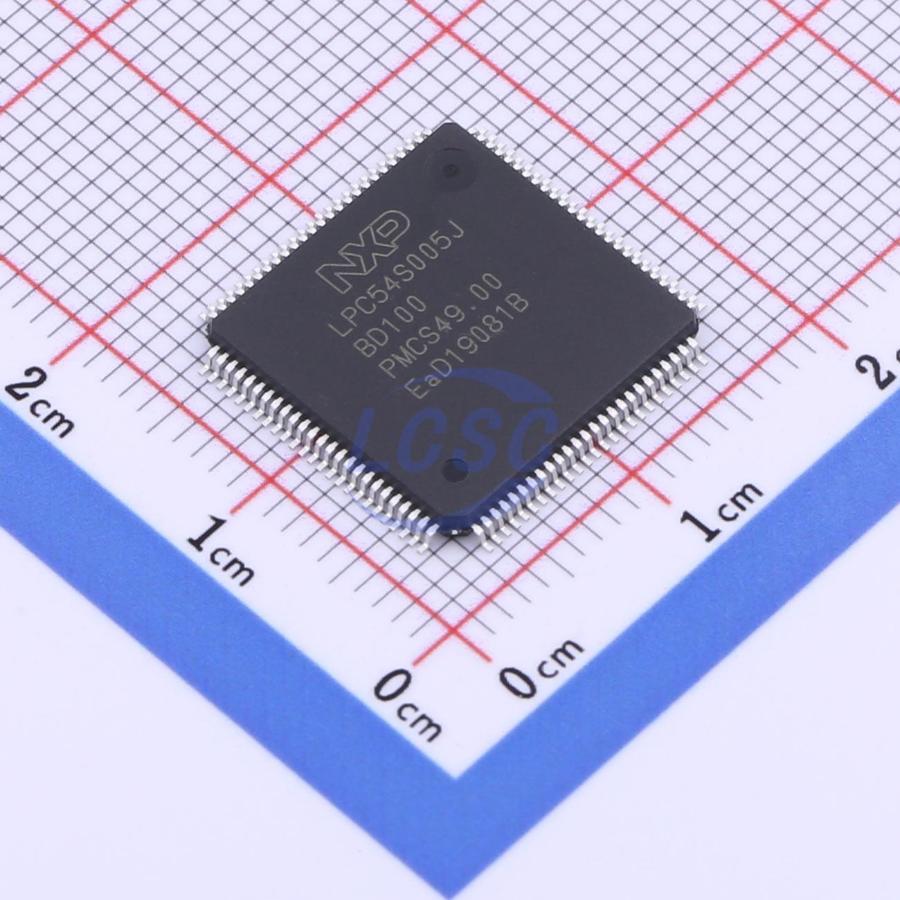
LPC54S005JBD100E NXP
NXP

LPC54S005JBD100E

ARM Cortex-M4 32 Bit 180MHz LQFP-100(14x14) Microcontrollers RoHS

LQFP-100(14x14)ROHS3 CompliantActive

32-bit ARM Cortex-M4 microcontroller

Manufacturer
NXP
Manufacturer part #
LPC54S005JBD100E
Store part #
C1339478
Package / case
LQFP-100(14x14)
Packaging
Tray
Datasheet (PDF)

Every Order Guarantee

100% Authentic · 30-Day Return or Replacement · policy

9 in stock

#C1339478

Stock & price checked 27 h ago

QuantityUnit pricePack price
1+₹1,141.93₹1,141.93
10+₹971.90₹9,719.00
30+₹868.19₹26,045.70
90+₹781.44₹70,329.60

1 × ₹1,141.93

₹1,141.93

excl. GST

₹1,347.48 incl. 18% GST

Need volume or a scheduled delivery? Request a quote
  • Dispatch in 15-18 working days
  • GST invoice with every order
  • Standard pack: 90 per tray

LPC54S005JBD100E

₹1,141.93 for 1 + GST

Need this with the rest of your board? Upload the BOM — we price every line.Upload BOM

Specifications

ADC (Bit)
12bit
Number of I/O
64
Operating Temperature
-40℃~+105℃
Program Memory Type
ROMless
Voltage - Supply
1.71V~3.6V
CPU Core
ARM Cortex-M4
Core Size
32 Bit
CPU Maximum Speed
180MHz
Oscillator Type
Built-in

Packaging & compliance

RoHS
ROHS3 Compliant
Lifecycle
Active
ECCN
5A992C
Packaging
Tray
Standard pack
90 / Tray
Sold per
Piece
Minimum order
1
Unit weight
14.8 g

Overview

The LPC54018JxM/LPC54S018JxM is a family of ARM Cortex-M4 based microcontrollers for embedded applications featuring a rich peripheral set with very low power consumption and enhanced debug features. The ARM Cortex-M4 is a 32-bit core that offers system enhancements such as low power consumption, enhanced debug features, and a high level of support block integration. The ARM Cortex-M4 CPU incorporates a 3-stage pipeline, uses a Harvard architecture with separate local instruction and data buses as well as a third bus for peripherals, and includes an internal prefetch unit that supports speculative branching. The ARM Cortex-M4 supports single-cycle digital signal processing and SIMD instructions. A hardware floating-point processor is integrated into the core. The LPC54018JxM/LPC54S018JxM family includes 4 MB of on-chip Quad SPI Serial Flash (connected on SPIFI interface), 360 KB of on-chip SRAM, one high-speed and one full-speed USB host and device controller, Ethernet AVB, LCD controller, Smart Card Interfaces, SD/MMC, CAN FD, an External Memory Controller (EMC), a DMIC subsystem with PDM microphone interface and Π|²S, five general-purpose timers, SCTimer/PWM, RTC/alarm timer, Multi-Rate Timer (MRT), a Windowed Watchdog Timer (WWDT), ten flexible serial communication peripherals (USART, SPI, I2S, I2C interface), Secure Hash Algorithm (SHA), AES-256 engine, Physical Unclonable Function (PUF), secure boot features, 12-bit 5.0 Msamples/sec ADC, and a temperature sensor.

Key features

  • ARM Cortex-M4 core (version r0p1):
  • ARM Cortex-M4 processor, running at a frequency of up to 180 MHz.
  • Floating Point Unit (FPU) and Memory Protection Unit (MPU).
  • ARM Cortex-M4 built-in Nested Vectored Interrupt Controller (NVIC).
  • Non-maskable Interrupt (NMI) input with a selection of sources.
  • Serial Wire Debug (SWD) with six instruction breakpoints, two literal comparators, and four watch points. Includes Serial Wire Output and ETM Trace for enhanced debug capabilities, and a debug timestamp counter.
  • System tick timer.
  • On-chip memory:
  • Up to 4 MB of on-chip Quad SPI Serial Flash (connected on SPIFI interface).
  • Up to 360 KB total SRAM consisting of 160 KB contiguous main SRAM and an additional 192 KB SRAM on the I&D buses. 8 KB of SRAM bank intended for USB traffic.
  • General-purpose One-Time Programmable (OTP) memory for user application specific data and for AES keys.
  • ROM API support:
  • In-Application Programming (IAP) and In-System Programming (ISP).
  • ROM-based USB drivers (HID, CDC, MSC, and DFU).
  • Supports serial interface booting (UART, I2C, SPI) from an application processor, automated booting from NOR flash (SPI, quad SPIFI, 8/16/32-bit external parallel flash), and USB booting (full-speed, high-speed).
  • FRO API for selecting FRO output frequency.
  • OTP API for programming OTP memory.
  • Random Number Generator (RNG) API.
  • RSA API calls (LPC54S018Jx only).
  • Execute in place (XIP) from internal serial flash (in quad, dual SPIFI mode or single-bit SPI mode), and parallel NOR flash.
  • Secure Boot features on LPC54S018Jx devices:
  • Supports boot image authentication using RSASSA-PKCS1-v1_5 signature verification with 2048-bit public keys (2048-bit modulus, 32-bit exponent).
  • Supports Root of Trust (RoT) establishment by comparing the SHA-256 hash digest of the RoT public key with OTP memory contents.
  • Supports secure anti-rollback of images through revocation of image key certificate. Supports up to 8 revocations through OTP fuses.
  • Supports boot of AES-GCM encrypted images with a 128-bit symmetric key stored in OTP memory or a 256-bit symmetric key stored using on-chip SRAM PUF.
  • Secure Authentication Only Boot. Enforce booting of RSA-2048 signed images only.
  • Encrypted Image Boot. Enforce booting of AES-GCM encrypted images only.
  • Enhanced Image Boot. Enforce booting of encrypted then signed images only.
  • Security features:
  • AES-256 encryption/decryption engine with keys stored in polyfuse OTP (LPC54S018Jx only).
  • Random number generator can be used to create keys with DMA support.
  • Secure Hash Algorithm (SHA1/SHA2) module supports boot with dedicated DMA controller.
  • Physical Unclonable Function (PUF) root key using dedicated SRAM for silicon fingerprint. PUF can generate, store, and reconstruct key sizes from 64 to 4096 bits (LPC54S018Jx only).
  • Serial interfaces:
  • Flexcomm Interface contains up to 11 serial peripherals. Each Flexcomm Interface (except flexcomm 10, which is dedicated for SPI) can be selected by software to be a USART, SPI, or I2C interface. Two Flexcomm Interfaces also include an I2S interface. Each Flexcomm Interface includes a FIFO that supports USART, SPI, and I2S if supported by that Flexcomm Interface. A variety of clocking options are available to each Flexcomm Interface and include a shared fractional baud-rate generator.
  • I2C-bus interfaces support Fast-mode and Fast-mode Plus with data rates of up to 1Mbit/s and with multiple address recognition and monitor mode. Two sets of true I2C pads also support High Speed Mode (3.4 Mbit/s) as a slave.
  • Two ISO 7816 Smart Card Interfaces with DMA support.
  • USB 2.0 high-speed host/device controller with on-chip high-speed PHY.
  • USB 2.0 full-speed host/device controller with on-chip PHY and dedicated

Same category

More in Microcontrollers

View all